Spiral Medallion Crochet Table Runner Pattern
Beginner Friendly
Perfect for those just starting their crochet journey, with clear instructions and simple techniques
Single-Day Project
A satisfying project you can complete in a single afternoon or evening.
Handmade Gift
A beautiful keepsake — free forever. Read online or print at home.
About This Spiral Medallion Crochet Table Runner Pattern
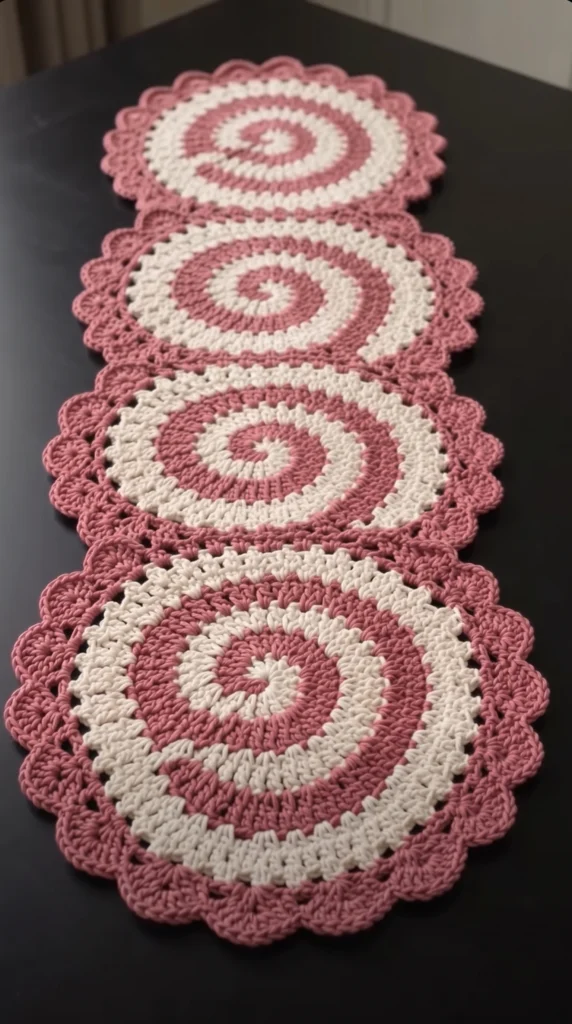
This crochet table runner pattern turns four spiral-striped medallions into one long, scalloped runner in rose and cream. Each medallion is worked in a continuous spiral, so the stripes curl toward the center like a peppermint swirl. A pink lace round and a row of shells finish every circle, and the four circles are joined as you stitch the last round.
The design is a good step up for crocheters who are comfortable with half double crochet in the round. You will change colors every two rounds without breaking the spiral, count stitches carefully through 13 increase rounds, and work a lace round and shell edging. Joining the medallions as you go means there is almost no sewing at the end.
Plan on 10 to 14 hours in total, about 2.5 to 3.5 hours per medallion. It suits a dining table, a console or a sideboard, and the same medallions work on their own as coasters or placemats if you make fewer of them.
Materials
- Cotton cord or worsted cotton yarn, rose pink about 200 g
- Cotton cord or worsted cotton yarn, cream about 150 g
- Crochet hook 5 mm
- Stitch marker 1 to 2
- Tapestry needle for weaving in ends
- Scissors
- Blocking mats and pins recommended
Abbreviations
MRmagic ringchchainsl stslip stitchscsingle crochethdchalf double crochetdcdouble crochetinc2 hdc in the same stitchskskipspspacest(s)stitch(es)[ ]repeat the instructions inside the brackets as directedSpiral Medallion (make 4)
- Rnd 1 (pink): 12 hdc in MR. Do not join; place a marker. (12)
- Rnd 2 (pink): [hdc in next st, inc] 6 times. (18)
- Rnd 3 (change to cream): [hdc in next 2 sts, inc] 6 times. (24)
- Rnd 4 (cream): [hdc in next 3 sts, inc] 6 times. (30)
- Rnd 5 (change to pink): [hdc in next 4 sts, inc] 6 times. (36)
- Rnd 6 (pink): [hdc in next 5 sts, inc] 6 times. (42)
- Rnd 7 (change to cream): [hdc in next 6 sts, inc] 6 times. (48)
- Rnd 8 (cream): [hdc in next 7 sts, inc] 6 times. (54)
- Rnd 9 (change to pink): [hdc in next 8 sts, inc] 6 times. (60)
- Rnd 10 (pink): [hdc in next 9 sts, inc] 6 times. (66)
- Rnd 11 (change to cream): [hdc in next 10 sts, inc] 6 times. (72)
- Rnd 12 (cream): [hdc in next 11 sts, inc] 6 times. (78)
- Rnd 13 (cream): [hdc in next 12 sts, inc] 6 times. (84) Sl st in the next st and fasten off cream. Tip: change each color by pulling the new color through on the last yarn over of the last stitch of the previous round.
Border (on each medallion)
- Rnd 14: Join pink with a sl st in any st. Ch 1, sc in each st around. Join with a sl st to the first sc. (84)
- Rnd 15 (lace round): Ch 3 (counts as first dc), ch 1, sk 1 st. [Dc in next st, ch 1, sk 1 st] 41 times. Join with a sl st to the top of the beginning ch 3. (42 dc and 42 ch-1 sps)
- Rnd 16 (shells): Sl st into the first ch-1 sp. [5 dc in the same sp, sk next ch-1 sp, sl st in the next ch-1 sp] 14 times. For the very first shell, work ch 3 as the first dc, then 4 dc. Fasten off after the last sl st. (14 shells)
Joining the Medallions
- Number the shell repeats of each medallion from 1 to 14 as you work Rnd 16, starting with the first shell.
- Medallion 1 is worked exactly as written, with no joins.
- On medallions 2, 3 and 4, work shell repeats 1 and 2 of Rnd 16 as follows: after the 5 dc, sk 1 sp, sl st in the next ch-1 sp as usual, then sl st into the matching between-shell sl st of repeats 8 and 9 on the previous medallion (repeat 8 for the first join, repeat 9 for the second).
- Work repeats 3 to 14 as written. Each medallion is now attached to the one before it at two points, with the shells meeting side by side.
- The free sides of each medallion are repeats 8 and 9, so the next medallion always has somewhere to attach. Medallion 4 has no free join sides to prepare.
Finishing
Weave in every end on the wrong side, taking extra care at each color change because the cotton is slippery. Wet-block the whole runner flat with pins, easing each scalloped edge into shape, and let it dry completely. Blocking evens out the spiral stripes, opens the lace round, and keeps the medallions lying flat on the table. If any join looks loose after blocking, stitch it closed with a few small whip stitches in pink.
Tips for Success
- Count at the end of every round for the first six rounds. A single missed increase there will make the whole disc cup instead of lying flat.
- Use cotton, not acrylic. Cotton has the body the shells and lace round need to hold their scalloped shape.
- Carry the idea of “staggered” color changes: change colors in the same spot each time and the spiral will look clean rather than jagged.
- Make all four medallions with the same tension. Work them in one sitting each if you can, or measure each against the last.
- Keep the joining sl sts loose so the joined edge can flex when you block.
Common Mistakes to Avoid
- Losing the marker in the spiral rounds. Fix it by counting back to a color change, then re-marking the first stitch of the round.
- Ruffling or cupping. This usually means too many increases or too tight a tension; pull back to the last round with the correct stitch count and redo it.
- Skipping the wrong ch-1 sp in the shell round. Always skip exactly one sp between shells and sl st in the next, or you will not end with 14 shells.
- Joining at the wrong repeat numbers. Mark repeats 1, 8 and 9 with removable markers so the medallions line up straight.
- Pulling color changes too tight. Leave the carried yarn slack so the join does not pucker the stripe.
Ways to Customize This Pattern
- Swap the colors for sage and cream, navy and white, or mustard and charcoal.
- Make the runner longer by adding more medallions, or shorter with just two or three for a console table.
- Work one medallion as a coaster by stopping at Rnd 9 and adding the border, which reduces the size noticeably.
- Use three colors instead of two by changing every two rounds in rotation.
- Use a thinner cotton and a 3.5 mm hook for a smaller, more delicate runner in the same stitch counts.
Frequently asked questions
Mercerized cotton or cotton cord around 4 mm thick gives the best result. It is firm, washable, and holds the shell edges open.
Yes. Work one medallion through Rnd 16 without any joins. Each one measures roughly 24 cm across, which suits a small plate or a candle.
Curling usually means the increase rounds are uneven or the tension is tight. Check that each round has exactly 6 more stitches than the one before, and go up a hook size if the fabric still cups.
Change colors on the last yarn over of the final stitch of a round, and always change in the same place. Do not cut the old yarn in a spiral round; just drop it and pick up the new color.
The finished Spiral Medallion Crochet Table Runner Pattern