Floral Swirl Crochet Table Runner Pattern
Beginner Friendly
Perfect for those just starting their crochet journey, with clear instructions and simple techniques
Single-Day Project
A satisfying project you can complete in a single afternoon or evening.
Handmade Gift
A beautiful keepsake — free forever. Read online or print at home.
About This Floral Swirl Crochet Table Runner Pattern
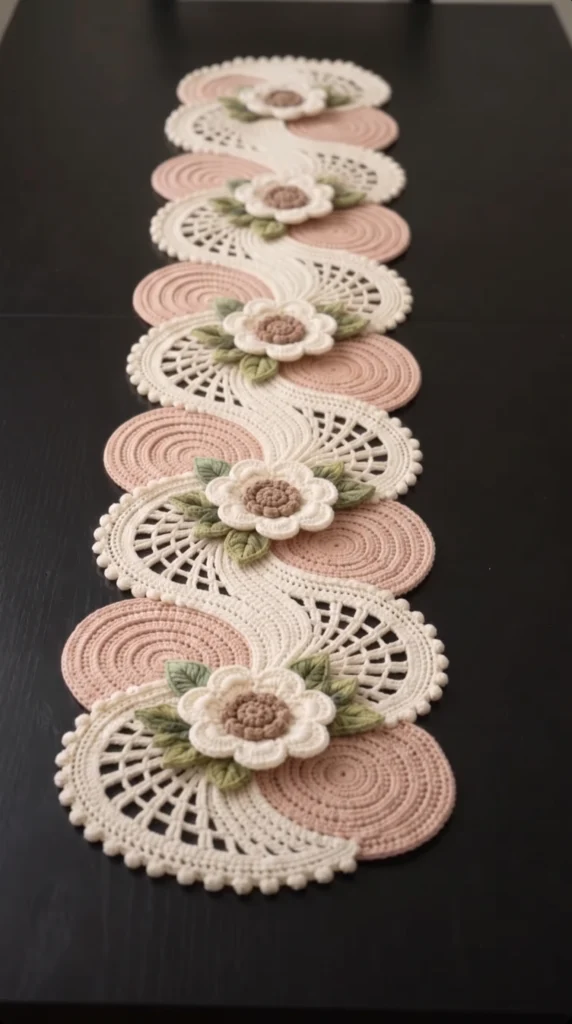
This crochet table runner pattern turns a row of flat motifs into one long, swirling piece. Blush pink discs alternate with cream lace fans edged in tiny bobbles, and five layered flowers with sage leaves sit where the motifs meet. The result looks like a single flowing design, but it is built entirely from small, portable pieces that you crochet separately and sew together at the end.
The pattern is advanced because of the number of pieces and the finishing, not because any single stitch is difficult. You will work flat spiral discs, turned lace rows with growing chain spaces, bobbles, a domed flower center, two petal layers and leaves. Plan on 18 to 24 hours in total. Because everything is made in motifs, it is easy to pick up for an hour at a time, and it suits crocheters who are comfortable with double crochet, chain spaces and sewing pieces together.
Work it in cotton and block it well. Cotton holds the lace open and keeps the discs flat, so the finished runner lies smoothly on a dining table, sideboard or dresser. If you only want a short version, three units make a lovely dresser scarf.
Materials
- Mercerized cotton, DK weight, blush pink about 150 m / 165 yd (2 x 50 g balls)
- Mercerized cotton, DK weight, cream about 130 m / 142 yd (2 x 50 g balls)
- Mercerized cotton, DK weight, warm taupe-brown about 15 m / 16 yd
- Mercerized cotton, DK weight, sage green about 40 m / 44 yd
- 3.0 mm crochet hook go down a size if your fabric is loose
- Stitch markers at least 2
- Tapestry needle
- Small amount of polyfill or yarn scraps for the flower centers
- Blocking mat and rustproof pins
- Fabric stiffener or sugar starch optional, helps the lace hold its shape
- Lighter green embroidery thread optional, for leaf veins
Abbreviations
MRmagic ringchchainsl stslip stitchscsingle crochethdchalf double crochetdcdouble crochetincincrease: 2 sc in the same stitchdecdecrease: sc2tog (single crochet two together)bobble4-dc bobble: [yo, insert hook in stitch, yo, pull up a loop, yo, pull through 2 loops] 4 times in the same stitch, yo, pull through all 5 loops on the hookBLOback loop onlyst(s)stitch(es)sp(s)space(s)RS / WSright side / wrong sidePink Disc (make 10)
Worked in pink as a flat circle in a continuous spiral. Do not join the rounds until the last one. Mark the first stitch of each round.
- Round 1: 6 sc in MR. (6)
- Round 2: inc in each st around. (12)
- Round 3: (sc, inc) x 6. (18)
- Round 4: (2 sc, inc) x 6. (24)
- Round 5: (3 sc, inc) x 6. (30)
- Round 6: (4 sc, inc) x 6. (36)
- Round 7: (5 sc, inc) x 6. (42)
- Round 8: (6 sc, inc) x 6. (48)
- Round 9: (7 sc, inc) x 6. (54)
- Round 10: (8 sc, inc) x 6. (60)
- Round 11: (9 sc, inc) x 6. (66)
- Round 12: sc in BLO of each st around. (66) Sl st in the next st and fasten off, leaving a 40 cm tail for sewing. The back-loop round creates the crisp ridge you see on the edge of each disc.
Lace Fan (make 5)
Worked in cream in turned rows. Every row has 9 dc (the spokes) with 8 chain spaces between them. The chain spaces grow by 1 chain each row, which opens the piece into a fan. Always work the dc into the previous row’s dc and skip over the chain space. Row 1 is the right side.
- Row 1: ch 4, sl st in the first ch to form a ring. Ch 3 (counts as dc), 8 dc in the ring. Turn. (9 dc)
- Row 2: ch 4 (counts as dc + ch 1). *Dc in next dc, ch 1; rep from * 6 more times. Dc in the 3rd ch of the beginning ch. Turn. (9 dc, 8 ch-1 sps)
- Row 3: ch 5 (counts as dc + ch 2). *Dc in next dc, ch 2; rep from * 6 more times. Dc in the 3rd ch of the beginning ch. Turn. (9 dc, 8 ch-2 sps)
- Row 4: ch 6 (counts as dc + ch 3). *Dc in next dc, ch 3; rep from * 6 more times. Dc in the 3rd ch of the beginning ch. Turn. (9 dc, 8 ch-3 sps)
- Row 5: ch 7 (counts as dc + ch 4). *Dc in next dc, ch 4; rep from * 6 more times. Dc in the 3rd ch of the beginning ch. Turn. (9 dc, 8 ch-4 sps)
- Row 6: ch 8 (counts as dc + ch 5). *Dc in next dc, ch 5; rep from * 6 more times. Dc in the 3rd ch of the beginning ch. Turn. (9 dc, 8 ch-5 sps)
- Row 7: ch 9 (counts as dc + ch 6). *Dc in next dc, ch 6; rep from * 6 more times. Dc in the 3rd ch of the beginning ch. Turn. (9 dc, 8 ch-6 sps)
- Row 8: ch 10 (counts as dc + ch 7). *Dc in next dc, ch 7; rep from * 6 more times. Dc in the 3rd ch of the beginning ch. Turn. (9 dc, 8 ch-7 sps)
- Row 9: ch 1 (does not count as a st). Sc in the first dc. *7 sc in next ch-7 sp, sc in next dc; rep from * 6 more times. 7 sc in the last ch-7 sp, sc in the 3rd ch of the beginning ch. Turn. (65 sc)
- Row 10 (bobble edge): ch 1. *Sc in each of the next 4 sts, bobble in next st; rep from * 12 more times. (13 bobbles, 52 sc, 65 sts total) This is a wrong-side row, so the bobbles pop toward the right side. Fasten off and leave a 40 cm tail.
Flower Center (make 5)
Worked in brown as a small domed button, in a continuous spiral.
- Round 1: 6 sc in MR. (6)
- Round 2: inc in each st around. (12)
- Round 3: (sc, inc) x 6. (18)
- Rounds 4-5: sc in each st around. (18)
- Round 6: (sc, dec) x 6. (12) Stuff firmly with a small ball of polyfill or yarn scraps.
- Round 7: dec x 6. (6) Fasten off, thread the tail through the front loops of the last 6 sts and pull closed. Leave a tail for attaching.
Back Petal Layer (make 5)
Worked in cream, joined at the end of each round. This is the larger layer with 8 rounded petals.
- Round 1: 8 sc in MR, sl st to the first sc to join. (8)
- Round 2: ch 1, 2 sc in each st around, sl st to the first sc. (16)
- Round 3 (petals): ch 1. *Sc in next st, 5 dc in next st; rep from * 7 more times, sl st to the first sc. (8 sc and 8 petals of 5 dc each, 48 sts) Fasten off and leave a 25 cm tail.
Front Petal Layer (make 5)
Worked in cream. This smaller layer has 6 petals and sits on top of the back layer.
- Round 1: 6 sc in MR, sl st to the first sc to join. (6)
- Round 2: ch 1, 2 sc in each st around, sl st to the first sc. (12)
- Round 3 (petals): ch 1. *Sc in next st, 4 dc in next st; rep from * 5 more times, sl st to the first sc. (6 sc and 6 petals of 4 dc each, 30 sts) Fasten off and leave a 25 cm tail.
Leaf (make 25)
Worked in sage green around a foundation chain. Each flower gets 5 leaves.
- Ch 9.
- Starting in the 2nd ch from the hook: sl st, sc, hdc, 2 dc, hdc, sc. (7 sts, worked in chains 2 to 8)
- Work 3 sc in the last ch to turn the tip of the leaf. (3 sts)
- Working along the underside of the foundation chain: sc, hdc, 2 dc, hdc, sc, sl st in the remaining 7 chains. (7 sts)
- Sl st into the first sl st to join. Fasten off, leaving a 15 cm tail. (17 sts around)
Finishing
Weave in all ends except the long sewing tails. Block every piece before you join anything. Steam the discs flat. Pin each fan out to a half circle on your blocking mat, with the bobble edge fully stretched, and spray or dip it in stiffener. Let everything dry completely.
Assemble each flower first. Stack the front petal layer on the back petal layer, turning it so the front petals sit over the gaps between the back petals. Sew the brown center on top, stitching down through all three layers. Tuck 5 leaves under the back layer at roughly 2 and 3 o’clock, 6 o’clock and 9 and 10 o’clock positions, and sew them in place with the green tails. If you like, embroider one straight stitch of lighter green down the center of each leaf to make a vein.
Lay the runner out on a flat surface, about 20 cm from the middle of one unit to the middle of the next. Each unit has one lace fan and two pink discs. Place the fan’s pointed hub on the center line with the bobble edge facing outward, and face the fans left in units 1, 3 and 5 and right in units 2 and 4. Put one pink disc under the fan on the bobble side and the other on the opposite side of the center line, so the fan overlaps both discs by about 3 cm. Whip stitch the overlaps with cream yarn, then sew the units to each other where the disc edges meet. Finally, stitch a flower over the joined center of each unit so it hides the seams. The finished runner measures about 100 x 26 cm.
Tips for Success
- Use mercerized cotton rather than a soft wool or acrylic. It gives the discs a crisp ridge and holds the open lace flat after blocking.
- Count the discs at rounds 3, 6, 9 and 12 (18, 36, 54 and 66 sts). It is much easier to fix a missed increase early than to rip back a finished disc.
- In the lace fan, count your 9 dc after every row. If a row has 8 or 10, you have worked into a chain space by mistake.
- Pin each fan out in a half circle and let it dry before you sew. A properly blocked fan opens up and lies flat.
- Make the flower layers and leaves in batches while you are watching something. They are quick, and having them done makes the final assembly feel fast.
Common Mistakes to Avoid
- A disc that cups into a bowl means an increase was skipped, and a disc that ruffles means one was doubled. Recount at the checkpoint rounds and rip back to the last correct count.
- A fan that curls or puffs up is usually worked with tight chains. Chain loosely, or use a 3.5 mm hook for the chains only, then block it flat.
- If the bobbles face the back, you worked Row 10 from the right side. Work it as a wrong-side row, as written, so they pop toward the front.
- Round leaf tips happen when the 3 sc in the last chain are skipped. Make sure they are all in that single chain.
- Sewing before blocking makes the pieces hard to line up. Block each motif first, then join them.
Ways to Customize This Pattern
- Change the palette: ivory and sage with a dusty blue disc, or a deep burgundy and cream version for the holidays.
- Make a shorter dresser scarf by using only 3 units (6 discs, 3 fans, 3 flowers), about 60 cm long.
- Use one disc and one flower as a round coaster, or a fan as a doily.
- Work the same counts in size 10 crochet cotton with a 1.5 mm hook for a smaller, finer heirloom version.
- Replace the flower centers with a wooden bead or a cluster of French knots.
Frequently asked questions
Each unit (one fan, two discs and one flower) adds about 20 cm. Make 3 units for about 60 cm, or 6 units for about 120 cm. Each extra unit uses roughly one-fifth of the yarn listed in the materials.
You can, but the lace fans will be softer and the discs may not stay as flat. If you use acrylic, steam block lightly and use a hook one size smaller for the discs.
Starch is optional, but it helps. A light dip in fabric stiffener or sugar starch keeps the fans open and the bobbles round, especially on a table that gets handled.
Hand wash it in cool water with a mild soap and do not wring it. Press it in a towel, then pin it flat to dry. If you used stiffener, you will need to reapply it after washing.
The finished Floral Swirl Crochet Table Runner Pattern