Daisy Garden Table Runner Crochet Pattern
Beginner Friendly
Perfect for those just starting their crochet journey, with clear instructions and simple techniques
Single-Day Project
A satisfying project you can complete in a single afternoon or evening.
Handmade Gift
A beautiful keepsake — free forever. Read online or print at home.
About This Daisy Garden Table Runner Crochet Pattern
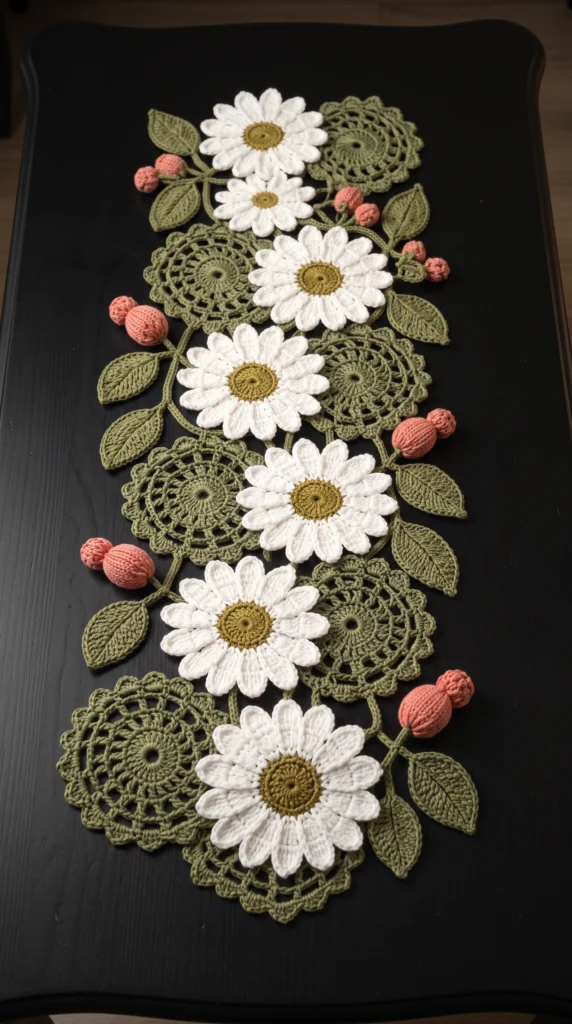
This daisy table runner crochet pattern builds a long garden vine out of separate pieces: seven layered white daisies with mustard centers, seven lacy green medallions, fourteen veined leaves, and coral berries on slim stems. Everything is worked separately, blocked, and then sewn together in a staggered line so the daisies overlap the lace like flowers resting on a mossy trellis.
It is an advanced project, mostly because of the number of different pieces and the assembly. The daisies use two layers of fan-shaped petals, the medallions are worked in lace rounds with chain arcs, and the berries are small stuffed ovals and spheres. Plan on 30 to 40 hours in total. Most of that time goes into the medallions and leaves, which work up quickly once you have the rhythm.
The finished runner measures roughly 85 cm long and 35 cm wide, and it suits a sideboard, a dining table, or a dresser. It is a good choice if you already crochet lace and want a long project with lots of small, satisfying pieces. The pieces also work well as a take-along project.
Materials
- DK mercerized cotton, moss green about 200 g
- DK mercerized cotton, white about 100 g
- DK mercerized cotton, mustard about 25 g
- DK mercerized cotton, coral about 25 g
- 3.25 mm crochet hook
- Tapestry needle
- Polyester fiberfill a small handful
- Stitch marker
- Blocking mats and rustproof pins
- Sewing thread matching the green and white optional, for securing pieces
Abbreviations
MRmagic ringchchainsl stslip stitchscsingle crochethdchalf double crochetdcdouble crochettrtreble crochetdtrdouble treble crochetinc2 sc in the same stitchdecsc2tog (single crochet 2 together)BLOback loop onlyFLOfront loop onlyst(s)stitch(es)spspaceLarge Daisy (make 6)
- Round 1 (mustard): 12 sc in MR. Join with a sl st. (12)
- Round 2: inc in each st around. (24)
- Round 3: *sc in next st, inc in next st*, repeat 12 times. Join with a sl st and fasten off mustard. (36)
- Round 4 (white): Join white in the BLO of any st of Round 3. Ch 1, sc in the BLO of each st around. Join with a sl st. (36)
- Round 5, back petals: *sl st in next st, (hdc, dc, tr, dtr, tr, dc, hdc) in next st*, repeat 18 times. Join and fasten off. (18 petals of 7 sts each)
- Round 6, front petals: Turn the daisy to the front. Join white in the FLO of any st of Round 3 (the loops left unworked). *Sl st in next st, (hdc, dc, tr, dc, hdc) in next st*, repeat 18 times. Join and fasten off. (18 petals of 5 sts each)
- Weave in the ends, leaving the mustard center tail to stitch the back flat.
Small Daisy (make 1)
- Round 1 (mustard): 12 sc in MR. Join with a sl st. (12)
- Round 2: *sc in next st, inc in next st*, repeat 6 times. Join and fasten off mustard. (18)
- Round 3 (white): Join white in the BLO of any st. Ch 1, sc in the BLO of each st around. Join with a sl st. (18)
- Round 4: *sl st in next st, (hdc, dc, tr, dc, hdc) in next st*, repeat 9 times. Join and fasten off. (9 petals of 5 sts each)
- Weave in the ends.
Lace Medallion (make 7)
- Round 1 (green): Ch 3 (counts as dc), 11 dc in MR. Join with a sl st to the top of the ch-3. (12 dc)
- Round 2: Ch 4 (counts as dc and ch 1), *dc in next st, ch 1*, repeat 11 times. Join with a sl st to the 3rd ch of the beginning ch-4. (12 dc, 12 ch-1 sps)
- Round 3: Sl st into the first ch-1 sp. Ch 1, sc in the same sp, ch 5, *sc in next ch-1 sp, ch 5*, repeat 11 times. Join with a sl st to the first sc. (12 sc, 12 ch-5 arcs)
- Round 4: Sl st across to the middle of the first ch-5 arc. Ch 3 (counts as dc), 2 dc, ch 2, 3 dc all in the same arc. Then work (3 dc, ch 2, 3 dc) in each of the next 11 arcs. Join with a sl st to the top of the ch-3. (12 shells of 6 dc each)
- Round 5: Sl st across to the first ch-2 sp. Ch 1, sc in the same sp, ch 7, *sc in next ch-2 sp, ch 7*, repeat 11 times. Join with a sl st to the first sc. (12 sc, 12 ch-7 arcs)
- Round 6: Sl st into the first ch-7 arc. In each arc work (sc, hdc, 5 dc, hdc, sc). Join with a sl st to the first sc and fasten off. (12 scallops of 9 sts each, 108 sts)
- Weave in the ends and block flat, pinning out each scallop.
Leaf (make 14)
- Foundation: With green, ch 13.
- Round 1: Starting in the 2nd ch from hook, work up the chain: sc, sc, hdc, hdc, dc, dc, dc, hdc, hdc, sc, sc (11 sts). Work 3 sc in the last ch (the tip). Turn and work down the other side of the chain: sc, sc, hdc, hdc, dc, dc, dc, hdc, hdc, sc, sc (11 sts). Join with a sl st to the first sc. (25)
- Round 2: Ch 1. Sc in the BLO of the next 12 sts. Work 3 sc in the BLO of the 13th st (the middle of the tip). Sc in the BLO of the last 12 sts. Join with a sl st and fasten off, leaving a long tail. (27)
- Vein: With a contrasting-free green strand, surface sl st a straight line from the base to the tip down the center of the leaf, working into the front of the stitches.
- Block lightly so the leaf keeps a gentle point.
Large Berry (make 7)
- Round 1 (coral): 6 sc in MR. (6)
- Round 2: inc in each st around. (12)
- Round 3: *sc in next st, inc in next st*, repeat 6 times. (18)
- Rounds 4-7: sc in each st around. (18)
- Round 8: *sc in next st, dec*, repeat 6 times. (12)
- Stuff firmly now, shaping into an oval.
- Round 9: dec 6 times. (6)
- Fasten off, thread the tail through the front loops, and pull closed.
Small Berry (make 7)
- Round 1 (coral): 6 sc in MR. (6)
- Round 2: inc in each st around. (12)
- Rounds 3-5: sc in each st around. (12)
- Stuff firmly into a ball.
- Round 6: dec 6 times. (6)
- Fasten off, thread the tail through the front loops, and pull closed. Leave a long tail for sewing.
Vines and Berry Stems
- Main vines (make 5, green): Ch 61. Sl st in the 2nd ch from hook and in each ch across. (60 sl sts) Fasten off leaving a tail.
- Berry stems (make 7, green): Ch 16. Sl st in the 2nd ch from hook and in each ch across. (15 sl sts) Fasten off leaving a tail.
- Sew one large berry and one small berry to the end of each berry stem, with the small berry slightly behind the large one.
Finishing
Pin all medallions, daisies and leaves flat, mist with water, and let them dry completely. On a flat surface, lay the medallions in a staggered column, alternating left and right of the center line, so each one overlaps its neighbor by about a third. Sew them together at three or four points where the scalloped edges touch.
Place a daisy on the opposite side of each medallion, so the flowers zigzag down the runner, with the small daisy second from the top. Stitch each daisy through its mustard center and through the back petals. Lay the vines along the gaps between the medallions and sew them down, then tuck leaves along the vines, alternating sides, and sew each one at its base. Finally, sew the berry stems into the vines at the outer edges. Weave in all ends and press the finished runner under a damp cloth.
Tips for Success
- Use mercerized cotton. It holds crisp petal and lace definition far better than acrylic or wool.
- Stitch the first medallion and one large daisy before committing to the rest. Check that the pieces overlap the way you like, and adjust the hook size if needed.
- Work the daisy back petals in the BLO of Round 4 and the front petals in the unworked FLO of Round 3 so the two layers sit neatly on top of each other.
- Count the ch-5 and ch-7 arcs in the medallions as you go. A missed arc throws the scallops off and shows when the piece is blocked.
- Block each type of piece together so the sizes stay consistent across all seven medallions.
Common Mistakes to Avoid
- Skipping the blocking step. Unblocked lace curls and hides the pattern, so pin out every medallion to the same diameter.
- Working the petals too tightly. If the daisies cup instead of lying flat, go up half a hook size for the petal rounds only.
- Overstuffing the berries. They should be firm but smooth. Lumpy berries usually mean too much stuffing before the decrease rounds.
- Sewing the leaves on before laying out the runner. Arrange everything flat first, then stitch, or the vines will end up crowded on one side.
- Joining the medallions at too many points. Three or four tacking points per join keep the lace flexible, and more makes it stiff.
Ways to Customize This Pattern
- Make the daisies from cream or pale yellow yarn for a warmer, vintage look.
- Change the berries to deep red or plum for an autumn version.
- Use only four medallions and daisies to make a shorter table topper or a long placemat.
- Add a ring of sc around the final scallop round of the medallions in a contrasting shade for a framed look.
- Turn single daisies and leaves into coasters or appliques by skipping the medallions and vines.
Frequently asked questions
Yes, but the size will change. A lace weight cotton with a 2.0 mm hook gives a smaller, finer runner, and a worsted weight with a 4.0 mm hook gives a bolder one. Make the first medallion and daisy before buying all the yarn.
Add more medallions, daisies and leaves in the same staggered pattern. Each extra medallion adds roughly 11 cm of length, and you will need about 25 g more green and 12 g more white per set.
Stuffing gives them their rounded shape, and the amount needed is very small. If you prefer a flat runner, you can work them as flat circles and skip the stuffing.
Cotton can be hand washed in cool water. Reshape it and pin it flat to dry. Avoid the machine, because it can pull the stitched joins loose.
The finished Daisy Garden Table Runner Crochet Pattern